
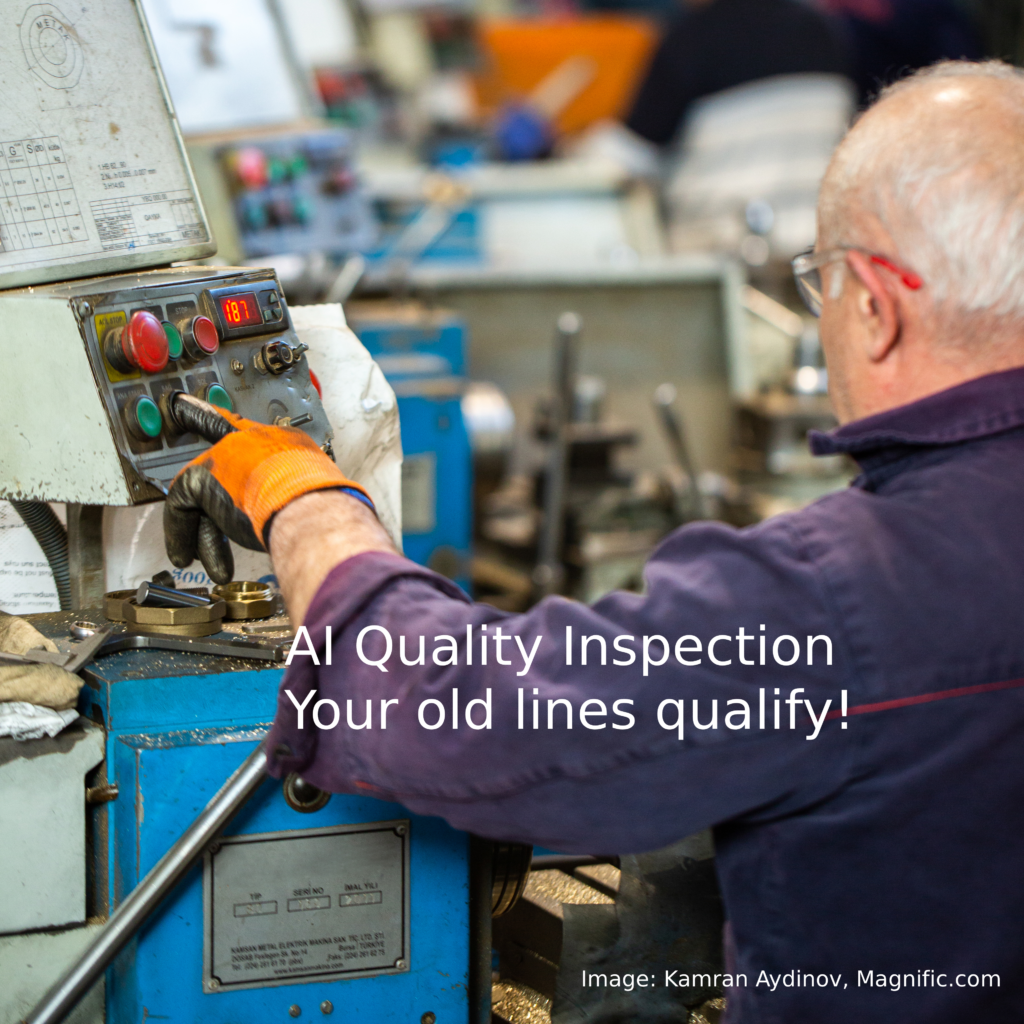
A lot of plants run equipment on their production lines that is years or even decades old. The machines still produce parts to specification, and the operators know their quirks and how to keep them running. The financial side is favorable as well: they were paid off and depreciated a long time ago.
The quality inspection on these lines is often outdated. Parts are checked by hand, or by a rule-based vision system. Both approaches have their shortcomings: manual inspection is impossible to keep consistent across inspectors and shifts; it’s expensive and often not practical for every part that is produced. Rule-based vision systems are inflexible, and new code must be written whenever a product changes or a new product is added.
Modern AI-based quality control has the solution to this problem. AI solutions can work perfectly well with older equipment and can be bolted onto the existing line with minor adjustments and additions, such as adding a camera and a light and then connecting to the PLC.
Old equipment is not a barrier for AI-based QC
The way AI models work is that they learn from examples of the parts a specific line produces, including the variation that line produces. What it needs is a clear view of the part and a representative set of labeled examples. Whether the machine manufacturing the part is two or thirty years old does not change how the model is trained or how it performs.
Retrofitting automated inspection onto an existing line requires a defined set of components and conditions:
- the system needs a clear view of the finished part
- It needs a way to know when to capture an image,
- a compute unit to run the model
- a connection to act on the result, usually a reject signal to the line controls.
All of these can be added to an existing machine. Since the inspection system only observes the output of the machine and doesn’t connect to the internal controls it isn’t limited by its age or controller generation
Conversely, the age of the equipment is more likely to affect a rule-based vision system that applies fixed parameters and looks for specific features at defined positions. It performs well when conditions are very stable, but an older line often produces parts with more variation. They might be well within specs, but register with the rule-based system as false positives.
What does need checking?
Equipment age is not a barrier. The condition of the line and its surroundings is worth checking before deployment, and it is separate from how old the machine is.
Two things matter most. The first is lighting. The model needs a clear and consistent view of the part. If the lighting at the inspection point varies or is inconsistent, it may need to be improved before the model can perform reliably. The second is data access. The system needs a way to move images off the line to the compute unit. A line that was not built with any data connection will need that path added.
Neither depends on the age of the production machine, and neither prevents a retrofit. A vendor who has done this before will check both when surveying the line and will tell you where work is needed before quoting a timeline.
Where does this leave you?
Old equipment does not prevent you from adopting AI quality inspection. The inspection system observes the finished part and learns from examples, so the age of the machine forming that part does not affect how it is trained or how it performs. What matters is a clear view of the part, a way to move the data, and a set of labeled examples to train on.
If you run older lines and have been assuming that rules you out, it does not. We are glad to review one of your lines and tell you what a retrofit would involve, including where the line would need work before it is ready. Just get in touch.
FAQs
How is the model trained, and where do the defect examples come from?
The model is trained on images captured from the line during normal production, labeled as good parts and as each defect type you want to catch. Common defects accumulate enough examples quickly. Defects that occur rarely take longer to collect a representative set for, and saved images of past defects help build it.
Does the model need retraining when our product or process changes?
Routine variation in parts, and gradual changes in line conditions do not require retraining. Retraining is needed when something genuinely new appears: a new product or SKU, a new part geometry, or a defect type the model has not seen before. In those cases you add labeled examples of the new case and retrain, rather than starting over.
Can one system inspect more than one product type or line?
Each product type is inspected by a model trained for it. A single installation can run multiple models, and many models can be managed across several lines or sites from one place. Adding a product type or a line adds a model, not a separate system.