
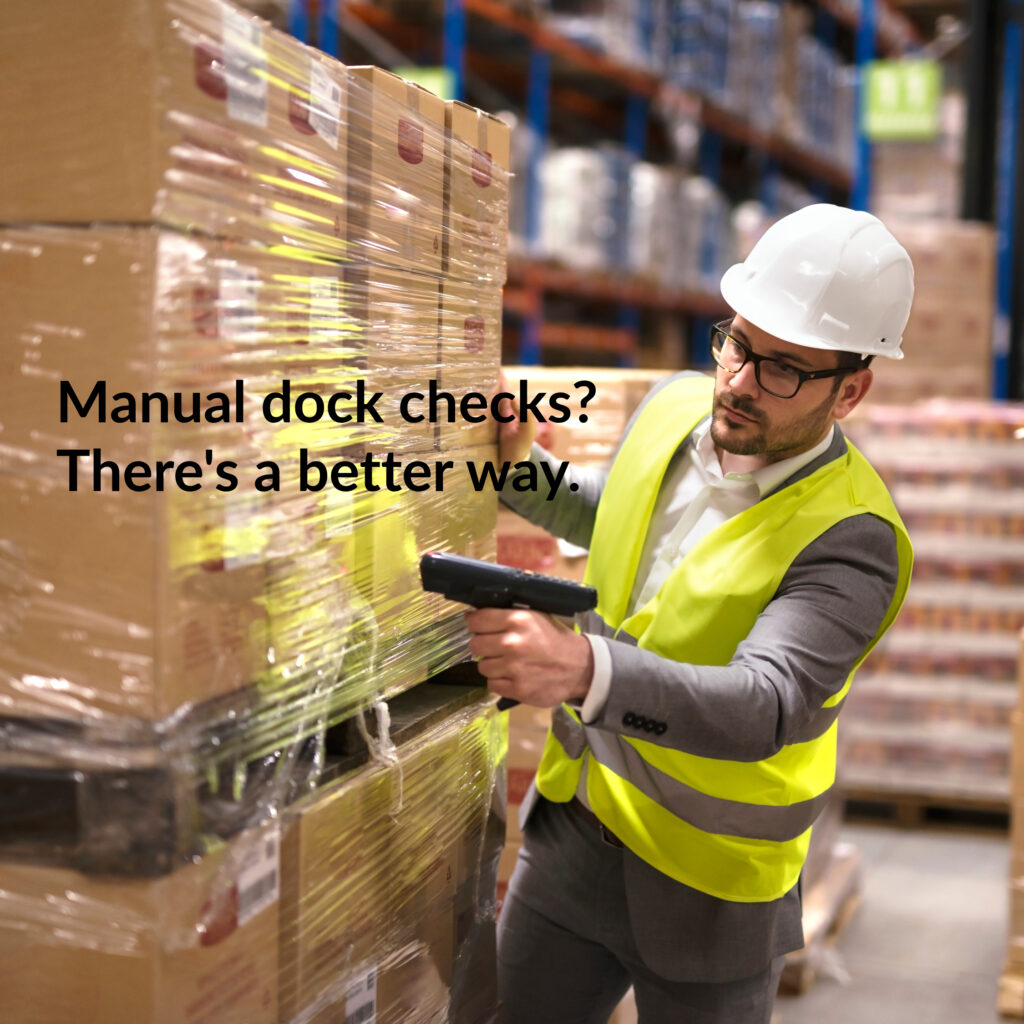
AI pallet verification is solving one of the most stubborn problems in high-volume manufacturing: the loading dock. Manual barcode scanning is slow, error-prone, and hard to staff — and errors don’t surface until a customer calls weeks later. This post covers how Shaw Industries, a $7B flooring manufacturer, partnered with Accella AI to deploy an AI vision system that automatically verifies every pallet before it leaves the dock — and what engineers and integrators need to know before doing the same.
Based on a three-part interview with Jeff Gentry, Staff Engineer of Global Operations at Shaw Industries, and Uli Palli, CTO of Accella AI, on the Visions: A Machine Vision and Automation Solutions Podcast.
TL;DR:AI pallet verification is one of the fastest-growing applications in high-volume manufacturing — and one of the most overlooked. Loading dock verification may seem routine, but for manufacturers like Shaw Industries it was a persistent source of errors, labor costs, and customer complaints. Shaw partnered with Accella AI to replace manual barcode scanning and visual pallet checks with an AI vision system using Lucid Vision Labs industrial cameras and deep learning.
The system automatically counts cases, reads barcodes via OCR, and integrates with existing PLC, WMS, and ERP systems — catching errors in seconds that human inspectors routinely missed. This three-part podcast series covers the technical build, real-world results, cybersecurity trade-offs, and what engineers and integrators need to know before deploying AI at the dock.
Why Is Loading Dock Verification Such a Hard Problem to Solve Manually?
Loading dock verification sounds simple: “all” you need to do is make sure the right products are on the right pallets before they leave the building. In practice, it is anything but.
At Shaw Industries, the challenge was compounded by scale and product complexity. Many of their flooring products look identical when boxed — same size, same packaging, but a different SKU. On a pallet stacked 60 cases high, an operator scanning every third box hours into his shift is not going to catch a mixed load. And then the customer finds out weeks later when they open boxes that don’t contain what they ordered.
Jeff Gentry, Shaw’s Staff Engineer of Global Operations, described the failure mode clearly: “If your job is to look at every single one and make sure they’re right — and all the boxes look the same and you’re on your 10th hour — you might be looking at every three boxes or the first ones on the side that are easiest. And then that’s how it gets out.”
The result: shipping errors, customer complaints, and a dock role that was difficult to staff and even harder to retain. High volume plus high variability plus manual process is a problem that simply adding headcount won’t solve.
What Does an AI Pallet Verification System Actually Do?
Shaw partnered with Accella AI to deploy the Accella Dock Check™ solution, integrating Lucid Vision Labs industrial cameras with Accella’s deep learning platform. The system captures front and back images of each pallet as it moves through the dock on a conveyor, then automatically:
- Counts every visible box on the pallet, even if they aren’t perfectly aligned
- Reads barcodes via OCR — even small ones on tightly packed loads
- Cross-references the read against the expected SKU for that shipment
- Flags discrepancies with a visual alert to the operator before the pallet can proceed
The key shift is timing. Errors are caught while the pallet is still on the conveyor, before it ever reaches the shipping door — not by a customer three weeks later. The entire verification happens in six to eight seconds.
The before-and-after description is telling: “In six to eight seconds on these large images, it could produce the output and tell us, ‘Hey, these three in this location are not the same as the barcode you’re looking for based on the SKU you put in.’ And then you can just go see very quickly — yep, those are different products.”
What Are the Hardest Technical Challenges in AI Dock Verification?
The engineering complexity behind what sounds like a simple “read barcodes, count boxes” task is significant. Uli Palli walked through the core trade-offs in detail.
Resolution vs. processing speed. To capture a full pallet with a single camera at sufficient resolution to read small barcodes, you need high-resolution images — but high-resolution images put heavy load on industrial PCs. Standard industrial PCs, unlike gaming-grade hardware, have real processing constraints. The team spent significant time finding the right camera-lens combination and then optimizing the software image pipeline to prevent the system from falling behind the conveyor speed.
Finding the right hardware at the right price point. The goal was not to build the most technically impressive system — it was to build one that would be economically viable to replicate across dozens of dock doors and facilities. That meant controlling hardware cost without sacrificing accuracy. Palli noted that the team used trial pallets in their lab, testing multiple camera and lens combinations before landing on the right setup.
Training data takes time. The AI model needs images to learn from — and collecting enough quality images to reach reliable accuracy takes time. This turns out to be the most persistent challenge across all Accella AI deployments: “It took us quite a while to get to a significant amount of images so that the model would have the desired accuracy. This is an ongoing process that everyone faces.” The good news: generative AI tools are now dramatically accelerating image annotation, compressing what used to take weeks into days.
For a deeper look at how data quality shapes AI outcomes, see our post on data strategy for manufacturing AI.
How Did the System Integrate With Shaw’s Existing Infrastructure?
One of the concerns manufacturers consistently raise about AI is integration complexity — particularly with legacy systems that weren’t designed to talk to modern software. In this case, it was largely a non-issue.
Accella AI’s platform ships with standard integration protocols for PLCs, WMS, and ERP systems. No custom development was required to connect to Shaw’s existing infrastructure. Whether the PLC is Siemens, GE, or another common industrial controller, the platform handles it out of the box.
Shaw’s team used Ignition by Inductive Automation to bridge the AI system’s outputs with their own operator displays — giving dock operators clear, actionable visual alerts without requiring them to interact with the AI system directly. The system also integrates into Shaw’s broader robotics automation: the verified pallet data feeds downstream robotic systems that require accurate inputs to function correctly. If a pallet is wrong, the automation can’t build — so verification is not just a quality step, it’s a production dependency.
This is a good example of what AI-powered in- and outbound inspection looks like in a fully integrated manufacturing environment.
How Did Dock Operators React — and What Helped Them Adapt?
Operator buy-in is one of the most underestimated challenges in any AI deployment. Gentry described what he sees as the two camps that emerge in every rollout:
“There are really two camps: really excited, can’t believe AI can do this — and then there’s ‘there’s no way this will work’ or ‘I don’t want it to be part of my workflow.'”
The skeptics tend to have two concerns: fear that the technology will replace their job, and worry that they’ll be held responsible for errors the AI misses. Both are legitimate. The answer in this deployment wasn’t a culture campaign — it was performance. Once operators saw the system catching errors consistently, and realized their own job became easier (no more hand-scanning every box, no more blame when a mixed pallet slipped through), both camps came around.
Notably, Accella AI completed the entire installation remotely. Shaw’s integration team never needed to host on-site visits for the core deployment — a significant advantage for manufacturers with lean integration resources.
What About Cybersecurity — How Are Images and Data Handled?
In every enterprise AI conversation, cybersecurity surfaces — and this deployment was no exception. Shaw’s IT and OT security teams were deeply involved in the project, reviewing how the external vendor would access the system and how data would flow.
The architecture they landed on reflects a practical balance: inference happens on-premises. Images captured at the dock stay local. The only data that leaves the facility is training images shared with Accella AI for model improvement — and that data transfer is controlled.
Palli framed the broader challenge that every manufacturer will face as AI deployments scale: “Most of these systems have Linux as an underlying OS and cybersecurity in every company insists that you patch these systems all the time. So there’s a trade-off in terms of how much work it really causes to keep these systems updated versus the benefit you’re getting from AI.”
The tension between keeping systems patched and minimizing attack surface exposure isn’t going away — and with AI evolving rapidly, the update cadence only increases. Both Palli and Gentry agree: manufacturers need OT security policies in place before they start deploying AI at scale, not after.
How Do You Scale AI Pallet Verification Across Multiple Facilities?
Shaw’s current deployment is at a single distribution center, but expansion is already planned. Gentry confirmed the intent to roll out the system across multiple facilities and is exploring additional use cases — including using the same vision infrastructure to detect damaged boxes before shipment, a quality catch that the current system doesn’t yet cover.
The economics of scaling is also worth noting: AI vision systems that cost $300,000 to develop and deploy six years ago now land in the $50,000–$100,000 range. His expectation is that cost will continue to fall toward $10,000–$20,000 per deployment point — which changes the calculus fundamentally. At that price point, a manufacturer stops thinking about one inspection station and starts thinking about ten.
That shift creates its own challenge: managing a fleet of hundreds or thousands of AI systems across a plant network. Accella AI addresses this through its platform’s centralized lifecycle management — automated deployment, remote monitoring, and the ability to detect hardware degradation before it causes downtime. Palli described a real example: “We ran into some hardware difficulties due to a hard disk running too hot. But we had monitoring in place that alerted the team that there was going to be an issue with the hardware.”
The same platform that manages dock verification also supports AI-powered predictive maintenance and AI visual inspection — meaning manufacturers can scale a single AI infrastructure across multiple shop floor applications rather than managing separate systems for each use case.
What Are the Most Common Pitfalls Engineers and Integrators Should Avoid?
Both Gentry and Palli offered concrete advice for engineers approaching AI vision deployments.
Don’t assume the model does all the work. Gentry put it plainly: “People think you just get a model and plug it in and boom, it knows what you’re looking for. It’s really critical to have clean data, have data that matches what you’re going to look for in the real world.” A model is only as good as the data it was trained on — and the labeling of that data.
Get your AI readiness policies in place before the project starts. Palli’s advice: if you don’t have answers to the remote access, data ownership, legal, and cybersecurity questions before you kick off a project, you’ll spend the first six months answering them instead of building. The manufacturers who move fastest are the ones who did the organizational groundwork first. Our AI Readiness Self-Assessment is designed to help engineering teams work through exactly these questions before the first conversation with a vendor.
One model doesn’t do everything. For complex product mixes, multiple models may be required — and that’s normal. Palli gave the example of trying to distinguish between products that look nearly identical: “If you’re looking for apples and oranges with one model, they might be so similar that you cannot generalize and make a good distinction. You may have a multi-modal operation where you have one vision system but it’s using multiple models.” Accept that accuracy may vary slightly between models — 99.5% and 99.1% are both excellent results.
Collaboration is make or break. Both speakers used exactly those words, both stressed that every stakeholder — internal integration team, external vendor, IT, OT security, operations, quality — needs to be aligned before execution begins.
FAQ
What is AI pallet verification?
AI pallet verification is the use of computer vision and deep learning to automatically confirm that the correct products are on a pallet before it is shipped or received. The system uses industrial cameras to capture pallet images, counts cases, reads barcodes via OCR, and cross-references the results against expected shipment data — replacing manual handheld scanning with a faster, more accurate automated process.
What AI system did Shaw Industries use for pallet verification?
Shaw Industries deployed the Accella Dock Check™ solution from Accella AI, combined with industrial cameras from Lucid Vision Labs. The system uses deep learning to count cases, read barcodes via OCR, and verify pallet loads against expected shipment data in six to eight seconds per pallet.
How accurate is AI pallet verification compared to manual scanning?
The system catches errors in seconds that human inspectors routinely miss, particularly on high-volume lines where operator fatigue and product similarity make 100% manual verification impractical. Manufacturers using AI for packing list validation report up to 99.9% accuracy. Manual scanning at hour ten of a twelve-hour shift on identical-looking boxes cannot reliably match this.
Does an AI pallet verification system require internet connectivity to operate?
No. In Shaw’s deployment, inference runs on-premises and dock images stay local. Training images are shared with Accella AI for model improvement in a controlled, explicit process — but real-time verification does not depend on cloud connectivity. This edge-first architecture also removes latency and reduces cybersecurity exposure.
How long does it take to deploy an AI dock verification system?
The physical installation can be completed in days. The more time-consuming phase is building the training image library to achieve target model accuracy, though generative AI tools are compressing this from weeks to days. Accella AI completed Shaw’s core deployment entirely remotely, without on-site visits.
Does AI pallet verification require custom integration with existing WMS or ERP systems?
In most cases, no. Accella AI’s platform uses standard integration protocols and connects to common PLCs (Siemens, GE, and others) out of the box. Shaw used Ignition by Inductive Automation to build custom operator displays, but the AI system itself did not require custom integration development.
What is the biggest challenge in scaling AI pallet verification across multiple facilities?
Managing and maintaining a fleet of AI systems — keeping software patched, monitoring hardware health, and updating models — is the primary scaling challenge. Manufacturers need centralized platform management and clear OT security policies before scaling beyond a pilot deployment. The cost per deployment point is also falling rapidly, from $300,000 six years ago to $50,000–$100,000 today, with further reductions expected.
Where can I learn more about AI in- and outbound inspection?
Start with Accella AI’s in- and outbound inspection page and the full three-part podcast series on the Visions podcast. You can also download the Dock Check use case PDF or take our AI Readiness Self-Assessment to evaluate your own process.
Accella AI builds AI solutions for the manufacturing shop floor, including the Accella Quality Box™ for AI visual inspection, the Accella PDM Bot™ for predictive maintenance, and the Accella Dock Check™ for in- and outbound inspection. Get in touch to discuss your application.